Amortecimento e medidas
How the three numbers on every page are taken.
A number is only worth publishing if the method behind it is published too. This page is that method, in enough detail that you could repeat it on a pair you already own.
- Forefoot padding
- 5–16mm
- Heel padding
- 8–22mm
- Flex angle
- 22–45°
Why numbers instead of adjectives
Nearly every shoe sold for standing on your feet all day is described with the same handful of words. Those words cannot be compared with each other, cannot be checked, and cannot be wrong.
So we removed them. Instead of telling you a pair is comfortable, we tell you how many millimetres sit under the ball of your foot, how many sit under your heel, and how far the forefoot bends. Three readings, taken the same way on every pair, published on every page, and sortable against each other on one table.
Padding is read with a depth gauge on an uncompressed pair at two fixed points: the centre of the ball of the foot and the centre of the heel seat. Flex angle is the angle the forefoot reaches when the sole is bent by hand against a held heel and kept there for three seconds. Both are averaged over three pairs in size EU 38 and rounded to the nearest whole unit.
Padding under the forefoot
- A finished pair is taken from stock and left at room temperature for at least twelve hours, so nothing is compressed from packing.
- The footbed and everything under it is sectioned at the widest point across the ball of the foot.
- A depth gauge reads from the top surface of the footbed to the top of the outsole, at the centre of that section.
- Nothing is compressed during the reading. This is the uncompressed stack.
What is included: the footbed covering, the cushioning layer and the midsole. What is excluded: the outsole itself, because that is tread rather than padding, and its thickness is stated separately where it matters.
Padding under the heel
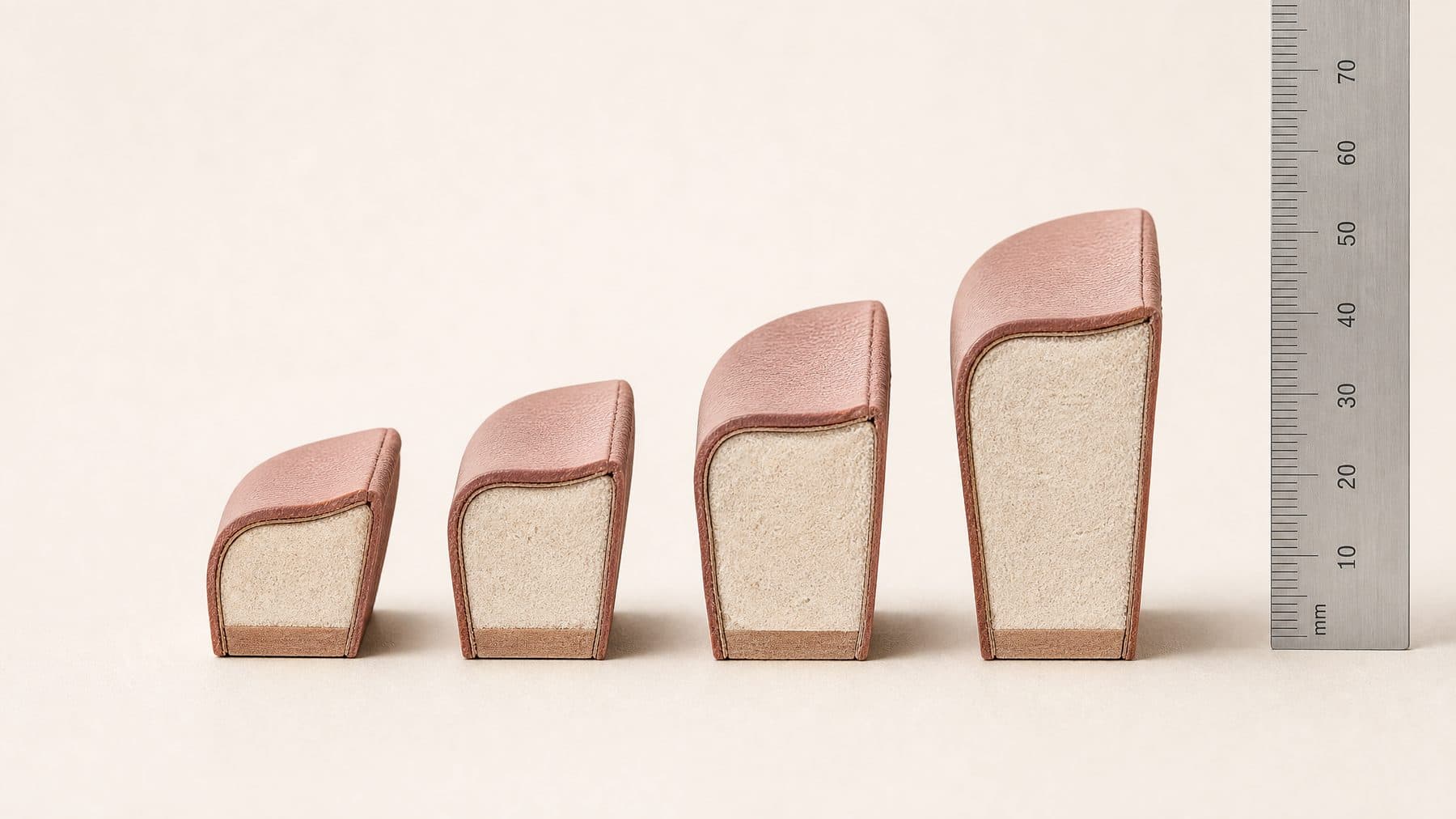
The same method, read at the centre of the heel seat rather than across the ball. On a pair with a raised heel the reading is taken from the top of the footbed to the top of the heel block, not to the ground — heel height is a separate figure and mixing the two would inflate the padding number.
Every pair in the range reads thicker at the heel than at the forefoot. The heel lands first and lands harder, and the stack is built to reflect that.
Forefoot flex angle
- The heel is held flat against a fixed surface in a soft clamp.
- The forefoot is pressed upward by hand with steady pressure, not forced to its limit.
- It is held there for three seconds.
- The angle between the flat plane and the sole at the ball of the foot is read with a protractor.
The three seconds matter. Leather and foam both keep giving under sustained load, so a reading taken immediately and a reading taken after ten seconds are different numbers. Three seconds is where we fixed it, and it is the same three seconds on every pair.
A higher flex angle means the sole bends more easily with your foot. A lower angle means more material stays flat underfoot but the roll through the step is less natural. That is a physical relationship, not a ranking — we do not say which end of it is better.
Heel height
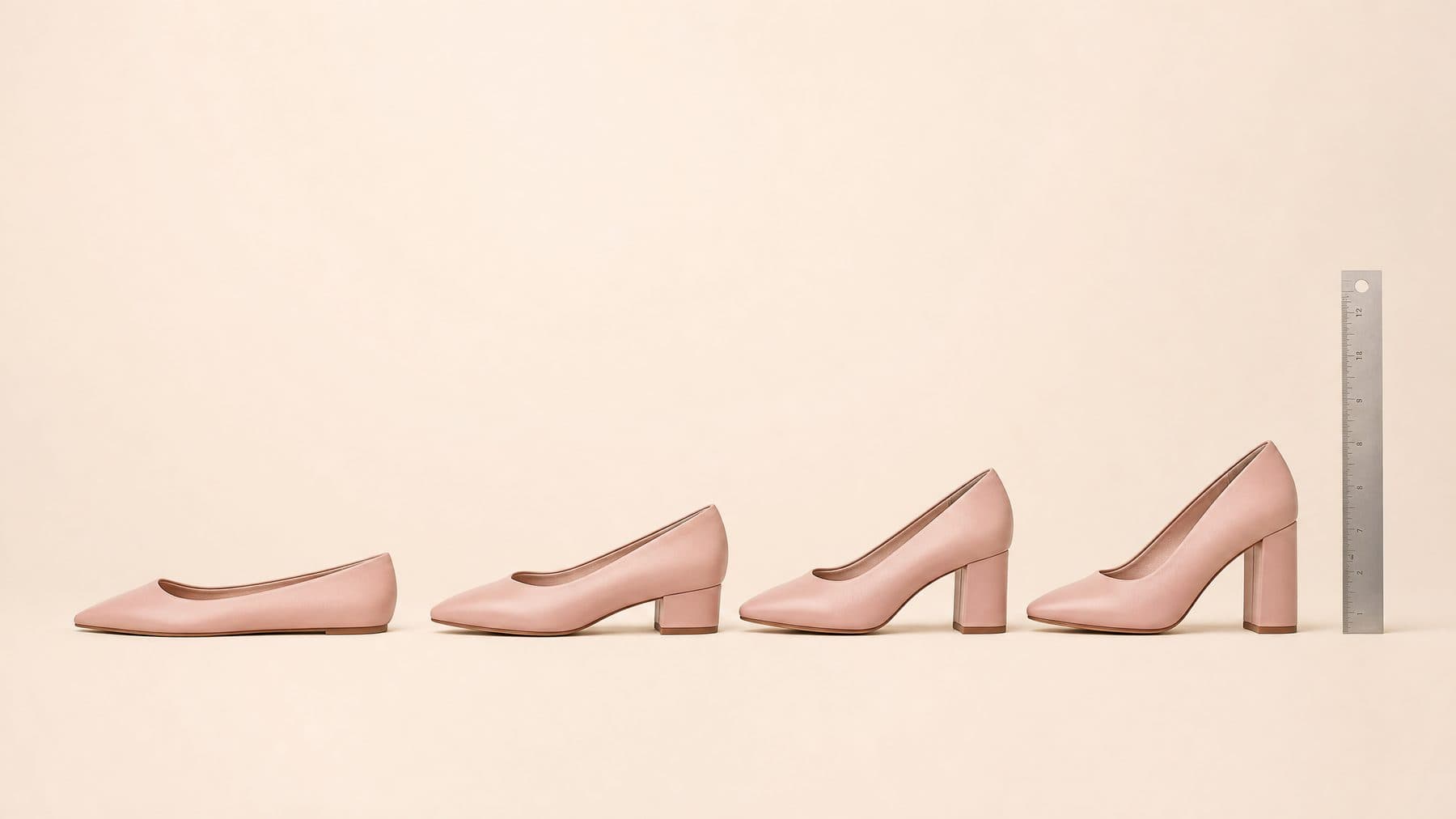
Measured externally, from the ground to the point where the heel block meets the upper at the back. Flat pairs are stated as the actual figure — a ballet flat reading 8 mm is published as 8 mm, not as zero.
Across the low block line, every ten millimetres of added heel costs roughly two degrees of forefoot flex. Both numbers are on every page so the exchange is visible rather than implied.
Last width and foot length
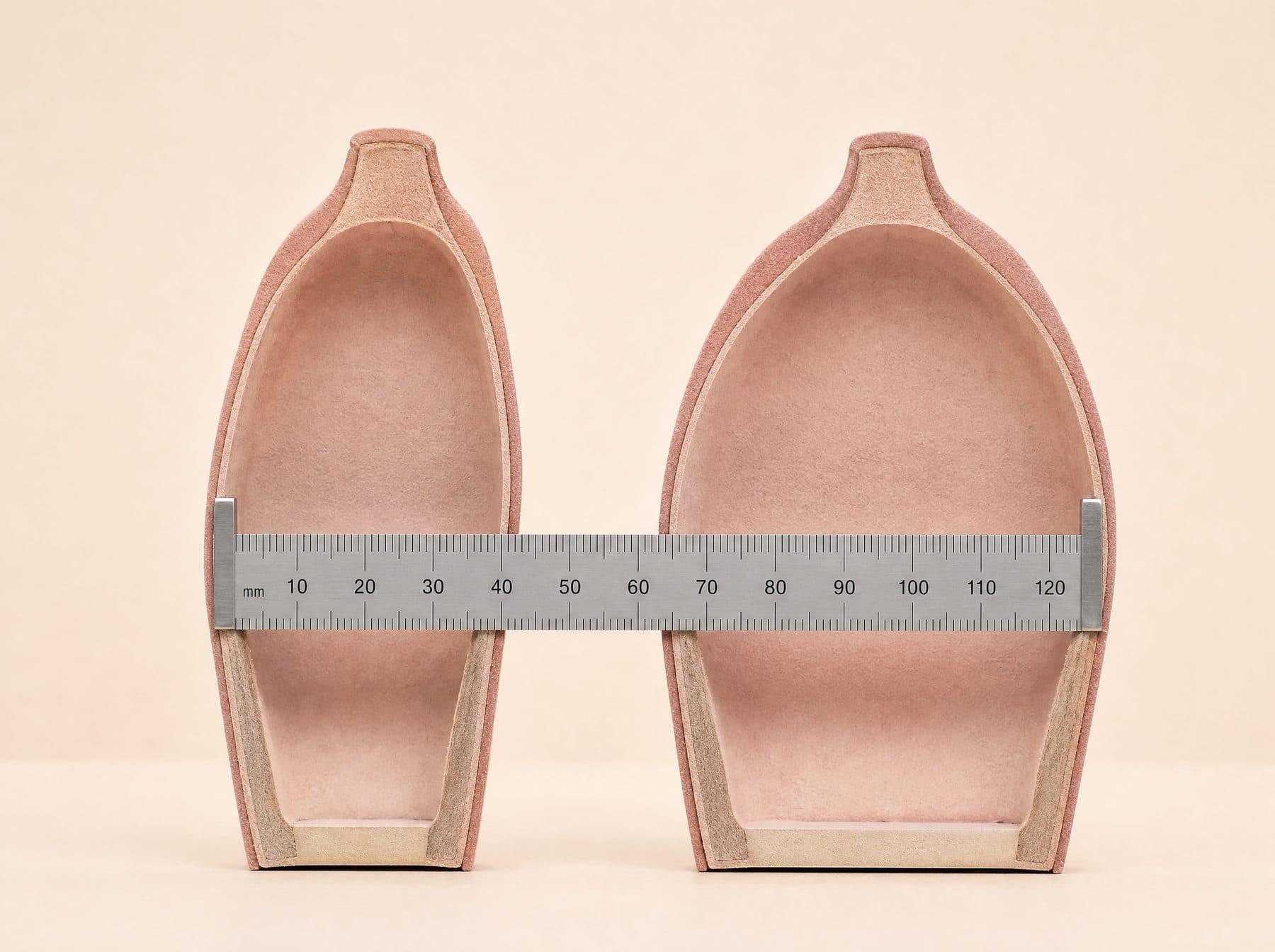
Internal forefoot width is measured across the inside of the shoe at the widest point of the ball, with the lining in place. It is published for every size on every product page. A wide last is cut seven millimetres wider than the standard last at every size; the length is unchanged.
Foot length is the length of foot the size is cut for, not the internal length of the shoe. There is toe room beyond it. Measure your own foot standing, heel against a wall, and compare directly — the sizing page walks through it.
Sampling, rounding and tolerance
- Every figure is the average of three pairs in size EU 38, taken from separate production batches.
- Padding is rounded to the nearest whole millimetre. Flex is rounded to the nearest whole degree.
- Padding varies by up to ±1 mm between pairs of the same model, and flex by up to ±3°. Leather and foam are not machined parts.
- Larger sizes carry marginally more material than EU 38 and smaller sizes marginally less. The published figure is the EU 38 reading in every case.
- Readings are retaken whenever a component supplier or a construction changes, and the page is updated before the new batch ships.
A pair that departs materially from its published figures is not in conformity with the contract, and the legal guarantee applies to it in the ordinary way.
What these numbers are not
These are physical descriptions of a shoe. They are not a description of what will happen to your feet.
- They are not a promise about comfort. Two people standing on the same 14 mm of padding for eight hours will not have the same day.
- They are not medical or podiatric advice, they do not describe an effect on the body, and they are not a claim about any foot condition.
- They are not a protection rating. Nothing we make is personal protective equipment, we do not test or certify slip resistance, and we make no claim about it.
- The standing hours filter on the comparison table filters on these published readings and on a threshold we chose. It is a filter, not a guarantee, and not medical advice.
If you have a foot problem you are trying to solve, speak to someone qualified to advise on it. We can tell you what is inside the shoe; we cannot tell you whether it is the right shoe for a condition, and we will not pretend otherwise.
Checking them yourself
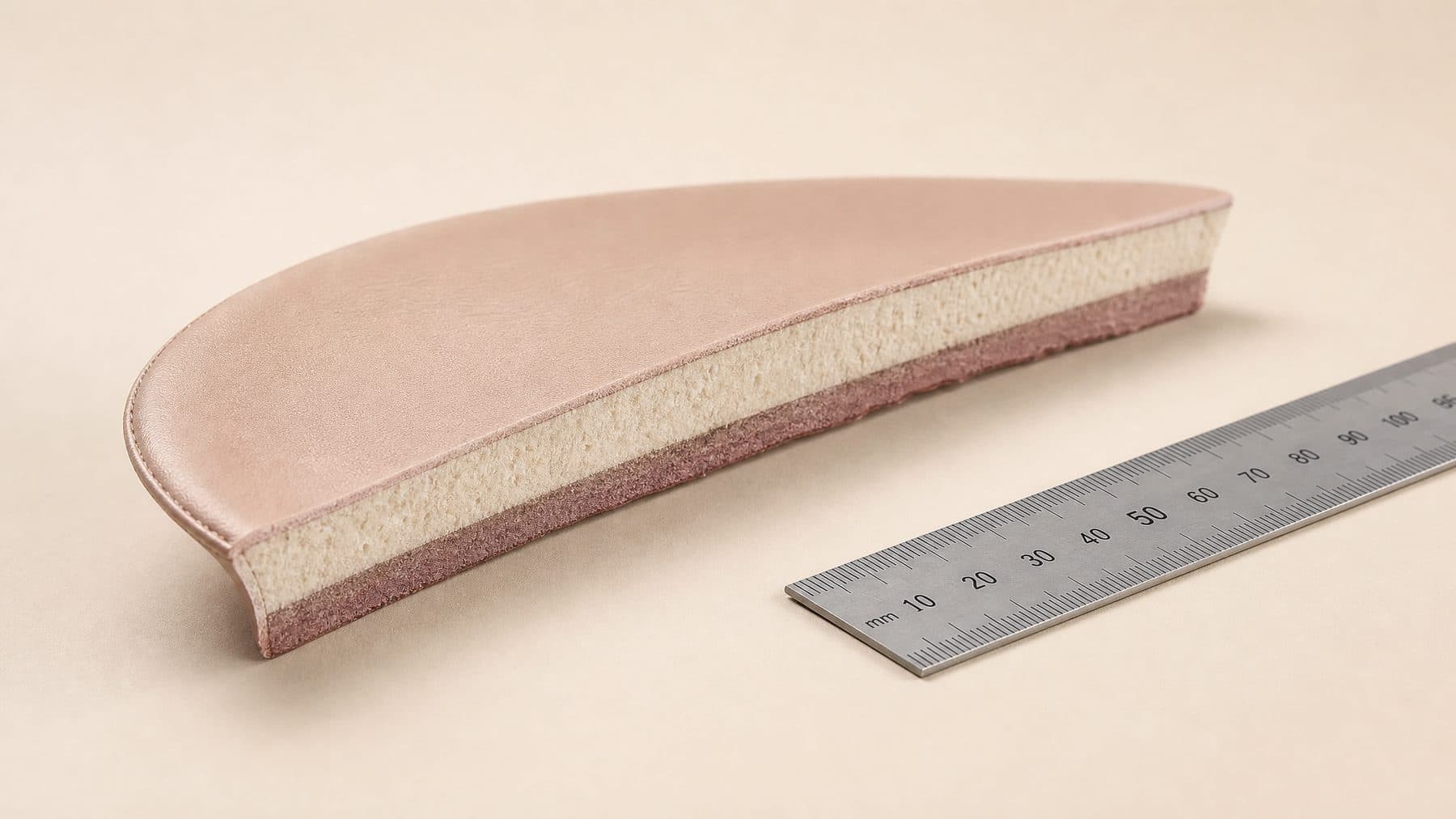
On any pair with a lift-out footbed you can check the padding without damaging the shoe. Lift the footbed out, stand a rule against its edge at the ball of the foot, and read the total thickness of footbed plus whatever is bonded under it. It will land within a millimetre or so of the published figure.
Flex is easier still: hold the heel flat, press the toe up, hold for three seconds, and read the angle. If your reading is more than three degrees off ours, write to us with the SKU from the box label and we will look at that batch.